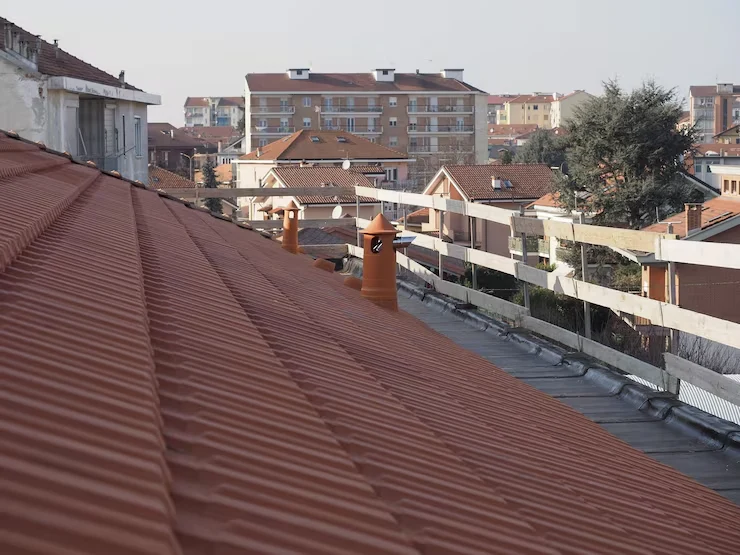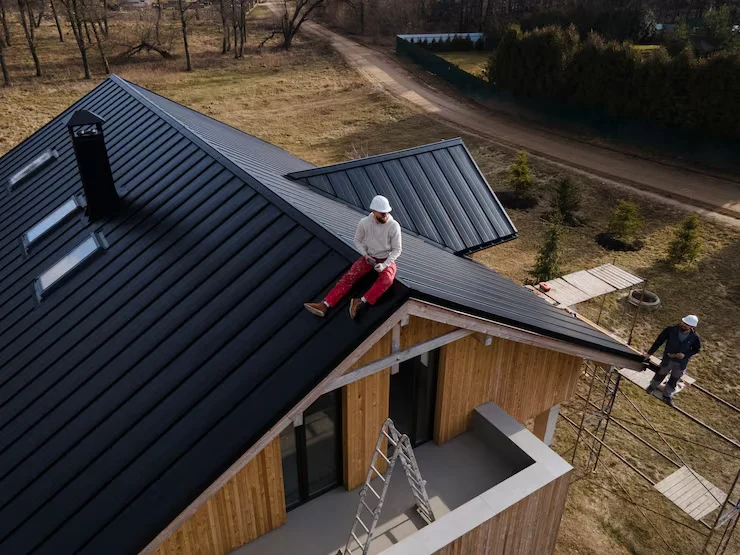
A roof in Lakeland works through long, hot summers, heavy rain and a hurricane season that runs half the year. The roofing materials on your home decide how well it handles all three, and how long it lasts before replacement. This guide compares the main options in plain language: asphalt shingles, metal, concrete and clay tile, and the membranes and coatings used on flat roofs.
Every comparison below comes from the Florida Building Code, federal guidance from FEMA and the U.S. Department of Energy, the Tile Roofing Institute, or published national figures from Fixr. Where a source gives a range, the range is shown as that source wrote it. Cost figures are national estimates, not Lakeland prices and not a quote.
Storm season in Florida runs from June 1 to November 30, with most activity from mid-August to mid-October, according to the National Hurricane Center. That is the weather every roof material on this page has to stand up to.
Roofing Materials Compared at a Glance
Four families of roof covering are common on Florida homes: asphalt shingles, metal, concrete or clay tile, and low-slope systems such as membranes and coatings. They differ most on lifespan, weight, the roof pitch they need and how they are tested for wind. The table below sets out what the cited sources say about each one.
| Material | Typical lifespan (source) | Weight and structure | Lowest roof pitch in the Florida code | Wind testing in the Florida code |
|---|---|---|---|---|
| Asphalt shingles (3-tab and architectural) | 20 to 30 years (Fixr) | Light; no structural note in the sources | 2 in 12 | Classified under ASTM D3161, ASTM D7158 or TAS 107 |
| Metal panels | 50 to 70 years (Fixr) | 1/4 in 12 for standing seam; 3 in 12 for lapped seams without sealant | Panels made under an approved third-party quality program | |
| Concrete tile | 50 years or more (Fixr) | 820 to 1,200 pounds per 100 square feet (Fixr) | Set by section 1507.3.2 | Wind loads per section 1609.6, installed to the FRSA/TRI Florida manual where it applies |
| Clay tile | Up to 100 years for clay and concrete (Fixr) | Heavy; the structure must be able to carry it (TRI) | Set by section 1507.3.2 | Same as concrete tile |
| Low-slope membranes and liquid roofing | 15 to 30 years for flat roofs in general (Fixr) | 1/4 in 12 | Varies by system |
Lifespans come from the Fixr roof replacement guide, the Fixr concrete tile guide and the Fixr flat roof repair guide. Code details come from Chapter 15 of the Florida Building Code, 2023 edition. Real lifespans depend on installation, attic conditions and upkeep, so treat every figure as a published average, not a promise.
Florida Weather and What It Asks of a Roof
A Lakeland roof has to resist wind lifting it from above, rain driven sideways under its edges, and strong sun that heats the surface for most of the year. Hurricanes test the first two. Summer heat tests the third every single day. A material that handles one of these well can still struggle with another.
Lakeland has felt all three in recent memory. During Hurricane Milton in October 2024, the National Weather Service recorded Polk County gusts generally between 80 and 90 mph. Lakeland Linder International Airport logged 8.93 inches of rain in one day, the highest on record there (NWS Tampa Bay).
FEMA’s hurricane guidance for sloped roofs explains why the edges matter so much. It says the roof border is more often at risk from wind uplift and wind-driven rain than the rest of the roof, and it recommends an inspection after high wind events (FEMA P-2181, Fact Sheet 3.3.1). That is true whatever material covers the roof.
Housing age matters too. The median Lakeland home was built in 1985, according to the Census Bureau’s American Community Survey 2024 one-year estimates (via Census Reporter). Set that against the lifespans in the table above, and the age of the current roof becomes the first thing to check before choosing the next one.
Asphalt Shingles on Lakeland Homes
Asphalt shingles cost the least up front of the options in Fixr’s national cost table. Fixr gives a standard asphalt shingle roof a life of 20 to 30 years. The Florida Building Code allows them only on roofs with a pitch of at least 2 in 12, and it requires each shingle to carry a wind classification.
The code’s wind rules for shingles are specific. Section 1507.2.7.1 says asphalt shingles must be “tested and classified in accordance with ASTM D3161, ASTM D7158 or TAS 107.” Table 1507.2.7.1 then sets the class required for each design wind speed, and the shingle wrapper must be labelled with the class it meets (Florida Building Code, Chapter 15). Section 1507.2.7 also sets a minimum number of fasteners per shingle.
FEMA’s guidance points the same way. It recommends replacing damaged shingles with “ASTM-rated shingles that meet the area’s local code regulations and wind requirements,” using ring shank nails for wood nailing, and placing nails in the manufacturer’s nailing zone (FEMA P-2181). When a whole roof is replaced, FEMA suggests an upgraded underlayment under the new covering for an extra layer of water resistance.
On cost, Fixr’s national figures put an asphalt shingle roof at $6,000 to $10,000 and an architectural shingle roof at $8,000 to $32,000, for a 1,700 square foot home with about 2,000 square feet of roofing (Fixr). These are national estimates, not Lakeland prices.
Three-Tab and Architectural Shingles
Shingles come in two main styles, three-tab and architectural, and Fixr prices them separately. Fixr’s guide to roofing materials says architectural and premium shingles cost more than other popular shingles. Both styles fall under the same Florida code wind rules described above, so each product must carry its own wind class.
Fixr’s national cost table lists the two separately, with architectural shingles running higher at the top of the range (Fixr). The sources used here do not give separate lifespans for each style, so this guide does not state one. The full side-by-side, including ridge cap shingles, is in architectural vs 3-tab shingles for Lakeland roofs.
Shingle Color and the Florida Sun
Shingle color changes how hot the roof gets. Dark materials absorb more sunlight and warm up, while white or special “cool color” products absorb less, according to the U.S. Department of Energy. The DOE lists cool asphalt shingles among the steep-slope products on the market, so a reflective shingle is a real option.
The DOE Guide to Cool Roofs notes that cool asphalt shingles were selling for up to $0.50 per square foot more than conventional shingles when it was published in 2011. It also says white roofs are coolest, and that cool colors are a popular alternative where neighbors can see the roof. Color choices, fading and what holds up under strong sun are covered in shingle roof colors for the Florida sun.
Metal Roofing in Florida Weather
Metal roofs last far longer than shingles in the published averages. Fixr gives metal a life of 50 to 70 years. The Florida Building Code allows standing seam metal on roofs as low as 1/4 in 12, much flatter than shingles allow, and FEMA advises choosing panels tested to the local wind load requirements.
The code adds two rules worth knowing. Section 1507.4 requires metal roof panels to be made under an approved third-party quality assurance program, and section 1507.4.1 says metal panels “shall be applied to a solid or closely fitted deck.” Minimum slopes depend on the seam: 3 in 12 for lapped seams without sealant, 0.5 in 12 for lapped seams with sealant, and 1/4 in 12 for standing seam (Florida Building Code, Chapter 15).
For storms, FEMA recommends “metal roof panels that have been tested to meet the local code regulations and wind load requirements of the area” (FEMA P-2181). For heat, the DOE lists metal among the cool roof products available for both steep and low-slope roofs (DOE).
Fixr’s national cost range for a metal roof is $14,000 to $38,000 for the same 1,700 square foot home (Fixr). That is well above shingles at the start, which is why lifespan is the main argument for metal.
Standing Seam Metal Panels
Standing seam is the metal style most often discussed for homes. The panels run from the ridge to the eave, and the joints between them stand up above the flat surface of the roof. Because the code allows standing seam down to a pitch of 1/4 in 12, it can cover roofs too flat for shingles.
How the seams lock, where standing seam has downsides, and what wind ratings look like for Florida homes are covered in standing seam metal roofs on Lakeland homes. Other metal styles exist, including lapped panels, and the code treats them differently on minimum slope, as listed in the section above.
Solar Panels and a New Roof
Solar panels sit on top of the roof covering, so the roof under them needs to outlast them or come off first. FEMA lists solar panels among the roof-mounted equipment that should be strongly connected so it does not come loose in a hurricane. Planning the roof and the panels together avoids paying to remove the panels later.
FEMA’s sloped-roof fact sheet names solar panels alongside vents, antennas and satellite dishes as rooftop equipment, and recommends strengthening roof-mounted equipment and its connections (FEMA P-2181). The timing questions are covered in solar panels and roof replacement in Lakeland.
Concrete and Clay Tile Roofs
Tile is the long-life option. Fixr says clay and concrete roofs can last up to 100 years, and its concrete tile guide lists 50 years or more. Tile is also heavy, so the roof framing must be able to carry it. The Florida Building Code sets tile wind loads by calculation rather than by a shingle-style wind class.
Weight is the first thing to check. Fixr’s concrete tile guide gives concrete tile a weight of 820 to 1,200 pounds per 100 square feet, and around 600 pounds for lightweight versions (Fixr). The Tile Roofing Institute says a home that has not had a tile or slate roof before should be inspected to see whether it needs more support. Fixr also says a structural engineer should decide whether the roof can bear concrete tile when switching from a lighter material.
On wind, section 1504.2 of the Florida Building Code says wind loads on clay and concrete tile “shall be in accordance with Section 1609.6.” Tile attachment, under section 1507.3.7, refers to the FRSA/TRI Florida High Wind Concrete and Clay Roof Tile Installation Manual, Seventh Edition, where it applies (Florida Building Code, Chapter 15). FEMA’s guidance on clay tile adds that tiles should be rated for the area’s wind loads and installed to the Tile Roofing Institute’s current guidance (FEMA P-2181).
Fixr’s national cost ranges are $14,000 to $24,000 for concrete tile and $14,000 to $28,000 for clay tile, for a 1,700 square foot home (Fixr). Cracked tiles, underlayment beneath the tile and repair choices are covered in concrete tile roofs on Lakeland homes.
Flat and Low-Slope Roof Systems
Flat roofs are not truly flat. The Florida Building Code requires built-up, modified bitumen, single-ply membrane and liquid-applied roofs to have a design slope of at least 1/4 in 12 so water drains. Fixr says flat roofs last 15 to 30 years on average, and that seams and pooled water are their usual weak points.
The code lists each low-slope system with the same minimum of 1/4 unit in 12, a 2 percent slope: built-up roofs in section 1507.10.1, modified bitumen in 1507.11.1, single-ply membranes such as EPDM and TPO in 1507.12.1, and liquid-applied roofing in 1507.15.1 (Florida Building Code, Chapter 15). Roof coatings have their own section, 1509.
Fixr’s flat roof guide names the common problems by type. On single-ply membranes like TPO and EPDM, seams are the weakest point. EPDM can shrink with sun exposure or temperature swings. Pooled water can wear down built-up and modified bitumen roofs quickly (Fixr). Where these show up on a Lakeland porch, carport or addition, flat roof repair in Lakeland explains the repair options.
Roof Coatings on Low-Slope Roofs
A coating is a liquid layer rolled or sprayed over an existing low-slope roof. The DOE lists elastomeric coatings among the cool roof products for low-slope roofs, alongside cool thermoplastic membranes and metal. A coating can make a sound roof more reflective, but it does not fix a roof that is failing underneath.
The DOE Guide to Cool Roofs defines a low-slope roof as a pitch of 2 in 12 or less, and says it is rarely worth replacing a sound roof just to make it more reflective. Silicone is one coating type. What it suits and where it falls short are covered in silicone roof coatings in Lakeland.
Heat, Reflective Roofs and the Attic
Florida sun heats a roof surface hard, and that heat moves into the attic and the living space below. The U.S. Department of Energy says a cool roof in a warm or hot climate can cut the yearly air-conditioning energy use of a single-story building by up to 15 percent. Cool versions now exist for most common roofing materials.
The DOE explains that a roof’s coolness depends on two measured properties: solar reflectance, the share of sunlight bounced away, and thermal emittance, how well the surface sheds heat. Both are rated from 0 to 1, and higher values mean a cooler roof. For steep roofs, the DOE lists cool asphalt shingle, clay tile, concrete tile and metal products (DOE).
The same guide adds two cautions. Many roofs become less reflective over time, so savings should be judged on aged values rather than new ones. A cool roof can also raise heating needs in winter, though the DOE says winter penalties can be smaller than summer savings.
Material is only half the story in the attic. Airflow through the attic carries heat and moisture out, and FEMA’s sloped-roof guidance lists soffit vents, ridge vents and gable vents among the roof parts that must also be secured against wind-driven rain (FEMA P-2181). How vents work with each roof type is covered in attic ventilation for Lakeland roofs.
The Roof Parts Every Material Depends On
The roof covering only works if the parts around it work too. Edge metal, fascia, gutters and skylights all sit where water and wind attack first. FEMA’s hurricane guidance treats edges, drainage and openings as their own parts of the roof system, each with its own upgrades, whatever covers the field of the roof.
FEMA’s sloped-roof fact sheet groups these parts by job (FEMA P-2181):
| Roof part | What FEMA says it does | More detail |
|---|---|---|
| Drip edge and eave flashing | Part of the edge metal along the roof border, which faces more wind uplift and wind-driven rain than the rest of the roof | Drip edge on Lakeland roofs |
| Fascia and soffits | Enclose the overhangs; vinyl and aluminum soffits are vulnerable to wind and wind-driven rain | Fascia and soffit repair in Lakeland |
| Gutters and downspouts | Carry water away from the roof; clogged or damaged ones leave the roof exposed | Gutter repair in Lakeland |
| Skylights | Overhead openings that FEMA lists among the parts to strengthen | Skylight leaks in Lakeland |
FEMA also stresses flashing. It says flashing around plumbing vents, chimneys, exhaust vent caps, dormers and skylights “must be integrated with the shingles and roof underlayment to prevent water from entering.” A new roof covering laid around old, failing flashing can still leak at those points.
Choosing a Roof Material for a Lakeland Home
The right material depends on the roof’s pitch, the strength of the framing, the budget and how long you plan to stay. Shingles cost least up front. Metal and tile last longer in the published averages but cost more, and tile needs framing that can carry it. Very low-slope roofs need membrane or liquid systems the code allows there.
A simple way to narrow the choice, based on the sources above:
- Check the roof pitch. Shingles need at least 2 in 12. Standing seam metal and low-slope systems go lower (Florida Building Code).
- Check the structure before choosing tile. A home that has not carried tile before should be inspected first (Tile Roofing Institute).
- Compare lifespan against how long you will own the home. A material that outlasts your ownership may still matter for resale and insurance.
- Ask about the wind classification or test on the exact product, and see it on the wrapper or product approval.
- Ask about cool or reflective versions of the material you prefer (DOE).
- Confirm permits and code details with your local building department, which decides how the code applies to your roof.
Reroofing has its own code rules. Section 1511.3 of the Florida Building Code says an existing roof must be torn off to the deck where it already has two or more layers of roof covering, and also where the existing covering is clay, cement or slate tile (Florida Building Code). Your contractor and building department confirm what applies.
Whatever you choose, regular checks from the ground help it reach its full life. A year-round roof care guide for Lakeland homeowners covers what to look for in each season. Work on the roof itself, including walking on tile or metal, belongs with a professional.
When you are ready to compare options for your own home, the Roof Repair Lakeland FL page on roof replacement in Lakeland explains what a replacement involves.
Frequently Asked Questions
What are the top 5 roofing materials?
The sources used here describe five common groups for Florida homes: asphalt shingles, metal, concrete tile, clay tile, and low-slope systems such as membranes and liquid-applied roofing. The Florida Building Code, Chapter 15 sets separate rules for each one. Which suits your roof depends on pitch, framing and budget.
What is the cheapest roofing material for a house?
In Fixr’s national cost table, asphalt shingles have the lowest range, at $6,000 to $10,000 for a 1,700 square foot home with about 2,000 square feet of roofing (Fixr). That is Fixr’s national market figure, not a Lakeland price. A local quote depends on the roof’s size, pitch and condition.
What are the best materials for a roof?
No one material is best for every home. Shingles cost least, metal lasts 50 to 70 years in Fixr’s figures, and tile can last up to 100 years but is heavy (Fixr). In Florida, the best choice also meets the code’s wind rules for your home and suits the roof’s pitch and framing.
What is the longest-lasting roof material?
Of the materials in this guide, tile lasts longest in the published averages. Fixr says clay and concrete roofs can last up to 100 years, compared with 50 to 70 years for metal and 20 to 30 years for asphalt shingles (Fixr). Installation and upkeep decide how long any one roof actually lasts.
What can I use instead of shingles on the roof?
The Florida Building Code covers several alternatives, including metal panels, concrete and clay tile, and, on low-slope roofs, built-up, modified bitumen, single-ply membrane and liquid-applied systems (Florida Building Code, Chapter 15). Tile needs framing strong enough to carry its weight, so have the structure checked before switching.