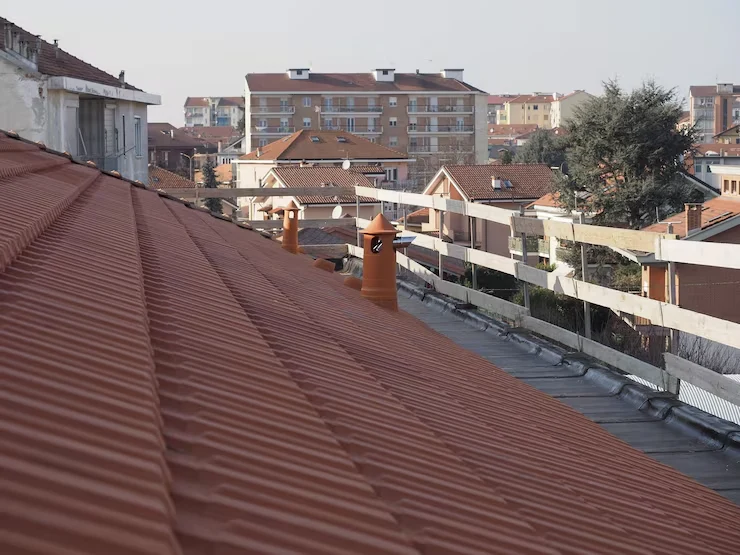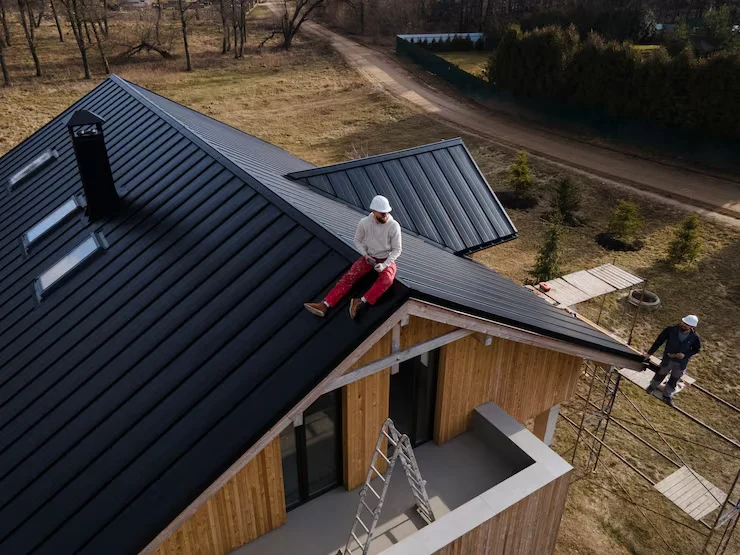
A storm can pass over Lakeland, leave the roof looking whole from the street, and still loosen shingles that fail in the next blow. Wind damage roof problems start with shingles that lift, bend and lose their seal, and only later show up as missing pieces or a stain on the ceiling. This guide covers what to look for and when to call for help.
Everything here comes from published sources linked in each section: a shingle maker’s technical bulletin, FEMA’s roof guidance, the National Hurricane Center and the National Weather Service, building science research and Florida law. Where no source gives an answer, this guide says so rather than guessing. For the rest of the year’s roof checks, see our year-round roof care guide for Lakeland.
Safety Comes First After a Windstorm
Before looking at the roof, look after people. Stay away from downed power lines and report them to your electric utility, or call 911 if anyone is hurt or a line is sparking. Keep everyone out of rooms where the ceiling sags or water is pouring in. Do not climb a ladder or walk the roof.
Wind damage checks in this guide are all made from the ground, from a window or from inside the house. A roof that has been through strong wind can have loose shingles, broken edges and debris sitting on it. Those are jobs for a professional with the right equipment.
If water is coming through the ceiling, move furniture and valuables out of the way, put down a bucket and towels, and leave the attic alone while the storm is still going. Then call a roofer for an emergency look.
Wind Damage on Roofs Starts With the Seal
Shingles with a sealant strip are glued to the row below by that strip. Strong wind can break that bond, lift the tab, flex it back and forth and crease it. The shingle maker IKO says that once the bond is broken, shingles are not likely to re-seal to their original strength.
IKO’s technical bulletin on high wind events lists the kinds of damage that strong wind can cause: “shingle blow-off, shingle tab uplift, broken shingle sealant bonds” and more (IKO bulletin R-82). The bulletin explains that the result is not always the same:
- Fully broken. In some cases the sealant bond is completely broken.
- Weakened. In other cases the bond is still there but its strength is compromised.
- Partly re-sealed. In some cases a broken bond can start to re-seal.
The bulletin also names things that change how a roof comes through a storm. They include the age of the shingle, the time of year and air temperature during the wind event, dust getting onto the sealant, and whether the shingle can lie flat again afterwards.
The Signs of Wind Damage on Shingles
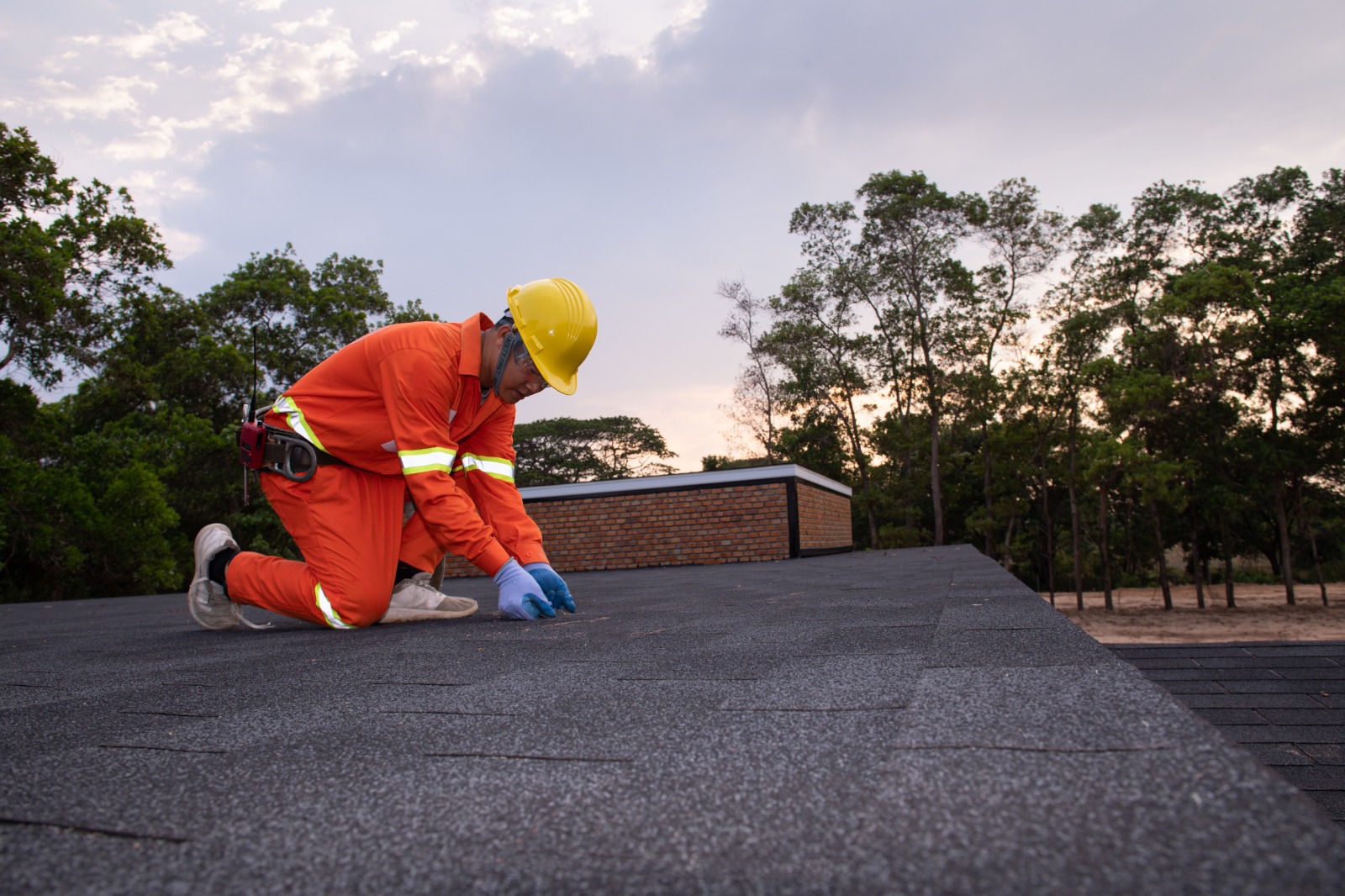
Wind damage on a shingle roof shows up as missing shingles, tabs that stand up or flap, creases across a tab, torn pieces, bare patches where granules are gone and holes from flying debris. Some of these show from the yard. Others, such as a broken seal under a shingle that still lies flat, need a close look.
IKO’s bulletin says “other damage may be present beyond a broken or weakened sealant bond” (IKO bulletin R-82). It names granule loss, punctures from airborne debris, and creasing of the shingle caused by flexing in the wind. The table sorts these signs by what a homeowner can see.
| Sign | What it looks like | Seen from the ground |
|---|---|---|
| Missing shingles | A dark gap or bare strip in the rows | Often |
| Lifted tabs | Edges that stand up, flap or cast a shadow | Sometimes, with binoculars |
| Creased tabs | A straight line bent across the shingle | Rarely |
| Torn shingles | Ragged edges or pieces in the yard | Pieces in the yard, yes |
| Granule loss | Bare or shiny patches, grit in gutters | Grit at downspouts, yes |
| Debris holes | Small punctures near branches or debris | Rarely |
| Broken seal only | Shingle lies flat but is no longer glued | No |
The Asphalt Roofing Manufacturers Association also tells owners to check for “cracked, curled or missing shingles” (ARMA FAQ). Hail leaves a different pattern of bruises and dents; our post on what hail damage looks like on a roof covers those signs.
Edges, Ridges and Soffits Take the Most Wind
The edges of a roof are where wind damage usually begins. FEMA says the roof border is more often at risk from wind uplift and wind-driven rain than the rest of the roof. That border includes the eaves, soffits, fascia, rake edges, drip edge and eave flashing, so look there first after a storm.
FEMA’s fact sheet on sloped roofs describes the roof border as “frequently at risk of damage from wind uplift pressures and wind-driven rain entry than the rest of the roof” (FEMA P-2181 Fact Sheet 3.3.1). The same sheet points to several weak spots:
- Soffits. Vinyl and aluminum soffit panels under the eaves are vulnerable to wind and wind-driven rain. A panel hanging loose or missing is easy to spot from the yard.
- Gable ends. FEMA says gable end walls are at risk in hurricanes because of their shape, and a failed gable end can let wind and rain inside.
- Ridge vents and turbines. FEMA lists securing or replacing ridge vents and turbines as an upgrade for wind.
- Gutters. Damaged or clogged gutters leave the roof exposed to wind and water damage, the sheet says.
For new roofs and repairs, FEMA suggests roof cement under shingles along eaves, rakes, hips and ridges to help hold them down.
Wind Speeds and the Damage They Can Do
No source gives one wind speed that always damages a roof. The National Hurricane Center says a Category 1 hurricane, with sustained winds of 74 to 95 mph, can damage the roof, shingles, siding and gutters of a well-built frame home. Higher categories bring damage to roof decking and then the roof structure.
The Saffir-Simpson Hurricane Wind Scale describes what well-built frame homes can expect at each level of sustained wind:
| Category | Sustained wind | Roof damage described by NHC |
|---|---|---|
| 1 | 74 to 95 mph | Damage to roof, shingles, vinyl siding and gutters |
| 2 | 96 to 110 mph | Major roof and siding damage |
| 3 | 111 to 129 mph | Major damage or removal of roof decking and gable ends |
| 4 | 130 to 156 mph | Loss of most of the roof structure and some exterior walls |
| 5 | 157 mph or higher | Total roof failure and wall collapse for a high share of framed homes |
Storms that are not hurricanes can still be strong. The Storm Prediction Center’s Enhanced Fujita Scale starts tornadoes at EF0 with 3-second gusts of 65 to 85 mph, and notes these are estimates based on damage. On the NWS Beaufort wind scale, force 10 winds of 55 to 63 mph are described as causing “considerable structural damage” on land.
Hurricane Milton and Polk County Roofs
Hurricane Milton in October 2024 is the most recent test of Lakeland roofs. The National Weather Service office in Tampa Bay reported peak wind gusts across Polk County generally between 80 and 90 mph, with a top reading of 87 mph at the Winter Haven airport before the instrument stopped reporting.
The NWS county impact narrative for Polk County also records heavy rain (NWS Tampa Bay, Milton impact narratives). Rainfall generally ran 10 to 15 inches over western Polk and 5 to 10 inches elsewhere. Lakeland-Linder International Airport recorded 8.93 inches in one day ending October 10, the highest one-day total in records that go back to 1948. Wind that lifts shingles and rain that follows it are a hard pair for a roof. A tab that lost its seal during the gusts lets wind-driven rain get under the shingle. That is one reason a roof that looked fine the morning after a storm can start to leak weeks later.
Older Shingles Lose More in the Wind
Shingle age matters. Research by the Insurance Institute for Business and Home Safety (IBHS) after Hurricane Laura and the 2020 Midwest derecho found shingle age to be a significant sign of risk for wind damage, even on roofs as young as 10 years old.
The finding is summarized on a National Association of Insurance Commissioners session page, which says “shingle age is a significant indicator of vulnerability to wind damage for roofs as young as 10 years old” (NAIC, roof age and wind performance). IKO’s bulletin also lists shingle age among the factors that shape how a roof performs in wind (IKO bulletin R-82).
IBHS runs ongoing research on the wind uplift of asphalt shingles and on how roof coverings hold up in severe storms (IBHS wind research). For an older roof, book a professional inspection after any strong storm.
Checks You Can Make From the Ground
A safe wind damage check needs no ladder and no climbing. Walk around the house, scan each roof slope and edge, look for pieces in the yard and grit at the downspouts, then check ceilings and walls inside. Take dated photos as you go, because they help both the roofer and any insurance claim.
Work through these steps in order:
- Walk the yard. Look for shingle pieces, ridge cap, flashing or soffit panels on the ground, and note which side of the house they are on.
- Scan each slope. Stand back far enough to see the whole roof. Look for dark gaps, rows that look uneven, and edges that stand up. Binoculars help.
- Check the edges. Follow the eaves, rakes and ridge line, where FEMA says wind does the most harm. Look for loose drip edge, lifted ridge cap and sagging soffit.
- Look at gutters and downspouts. Note bent or pulled-away gutters and piles of granules at the downspout outlets.
- Check inside. Look at ceilings and the tops of walls for new stains, bubbling paint or dripping, especially in rooms below the windward side.
- Photograph everything. Take wide shots and close shots with the date visible, before anything is moved or cleaned up.
Our guide on how to document roof damage for an insurance claim explains what photos and records to keep. Do not go up on the roof or into the attic during the storm to look.
Repairs for Wind-Damaged Shingles
The right repair depends on what the wind did. IKO says that if sealant bonds were broken by excessive wind and the shingles have no other damage, it recommends hand-sealing them under industry guidelines. Missing, torn or creased shingles need replacing, and the replacements must meet the wind rules for your area.
IKO’s bulletin gives its hand-sealing recommendation for shingles whose only damage is a broken bond (IKO bulletin R-82). Hand-sealing is roof work, done on the roof by a professional, not a homeowner job.
For replacement shingles, FEMA suggests replacing loose or damaged shingles with ASTM-rated shingles that meet local code and wind requirements (FEMA P-2181 Fact Sheet 3.3.1). The Florida Building Code, section 1507.2.7.1, requires asphalt shingles to be tested and classified under ASTM D3161, ASTM D7158 or TAS 107, with the class shown on the wrapper (Florida Building Code 2023, Chapter 15). When a whole roof is replaced, FEMA recommends an upgraded underlayment for an added layer of water resistance.
The Roof Repair Lakeland FL page on storm damage roof repair in Lakeland explains what a storm repair visit involves.
Wind Damage and Your Insurance Claim
Florida law sets a time limit for reporting wind damage. Section 627.70132 of the Florida Statutes says notice of a claim, including a windstorm or hurricane claim, must be given to the insurer within one year after the date of loss. A supplemental claim has 18 months. Confirm the details with your insurer.
The statute also defines the date of loss (Fla. Stat. s. 627.70132). For a hurricane, it is the date the hurricane made landfall. For a tornado, windstorm, severe rain or other weather event, it is the date the National Oceanic and Atmospheric Administration verifies the event. Our post on roof claim deadlines in Florida explains these time limits in more detail.
Coverage itself depends on your own policy, its deductible and its exclusions. Shingle warranties can also set wind limits, so read the warranty for the product on your roof. This guide does not promise any claim outcome. For questions about your policy, ask your insurer, and for a dispute, talk to an attorney.
Frequently Asked Questions
What wind speed can rip a roof off?
No single speed applies to every roof. The National Hurricane Center says Category 3 winds of 111 to 129 mph can remove roof decking and gable ends on well-built frame homes, and Category 4 winds of 130 to 156 mph can cause loss of most of the roof structure (NHC, Saffir-Simpson scale).
Can wind damage a roof without blowing shingles off?
Yes. IKO says strong wind can break or weaken the sealant bond that holds a shingle down, and can crease shingles by flexing them, while the shingle stays in place (IKO bulletin R-82). A broken seal often cannot be seen from the ground, so a professional inspection is the way to find it.
Do lifted shingles reseal on their own?
Sometimes, but not fully. IKO says a broken bond could start to re-seal in some cases, but that once sealant bonds have been compromised, shingles are not likely to re-seal to their original strength (IKO bulletin R-82). It recommends hand-sealing, which a roofer does.
How often should a roof be inspected for wind damage?
FEMA says a roof should be inspected at least twice a year, generally in spring and fall, and also after high wind events, with needed repairs done quickly (FEMA P-2181 Fact Sheet 3.3.1). Make your own checks from the ground and leave the roof itself to a professional.
How long do I have to report wind damage to my insurer in Florida?
Section 627.70132 of the Florida Statutes says notice of a windstorm or hurricane claim must be given within one year after the date of loss, and a supplemental claim within 18 months (Fla. Stat. s. 627.70132). Confirm the terms of your policy with your insurer.